PART 1
Dwarf, disease-resistant varieties for Milpitas: (fruit varieties are suggestions)
Winter to Early Spring:
1.Citrus Varieties:
Oroblanco Grapefruit: A sweet, seedless hybrid with a thick rind. Thrives in mild climates and matures from late November to March.
Rootstock: Dwarfing rootstock like ‘Flying Dragon’ trifoliate orange. Spacing: 8–10 feet apart. Placement: Sunny locations with well-drained soil; protect from frost.
2.Mandarins (e.g., ‘Kishu’, ‘Gold Nugget’):
Rootstock: Dwarfing rootstock such as ‘Flying Dragon’. Spacing: 8–10 feet apart. Placement: Full sun; suitable for containers or small garden spaces.
Spring to Early Summer:
1. Apricots: Variety: ‘Blenheim’ – A flavorful, early-season apricot.
Rootstock: ‘Citation’ (dwarfing). Spacing: 10–15 feet apart. Placement: Mid-slope areas with good drainage; avoid frost pockets.
2. Peaches/Nectarines: Variety: ‘Snow Queen’ White Nectarine – Sweet, early-season fruit.
Rootstock: ‘Citation’ (dwarfing) Spacing: 10–15 feet apart. Placement: Mid-slope with full sun exposure.
Summer:
1.Plums/Pluots: Variety: ‘Santa Rosa’ Plum – A versatile, disease-resistant variety.
Rootstock: ‘Citation’ (dwarfing). Spacing: 10–15 feet apart. Placement: Mid-slope; ensure good air circulation.
2.Figs: Variety: ‘Black Mission’ – A prolific producer with sweet fruit.
Rootstock: Standard (naturally small tree). Spacing: 10–15 feet apart. Placement: Upper slope; tolerates drier conditions.
Fall:
1.Apples: Variety: ‘Anna’ – A low-chill, early-harvest apple suitable for milder climates.
Rootstock: M27 or M9 (dwarfing). Spacing: 8–10 feet apart. Placement: Lower slope; requires well-drained soil.
2.Persimmons: Variety: ‘Fuyu’ – A non-astringent, sweet persimmon. Rootstock: D. Lotus (semi-dwarfing). Spacing: 12–15 feet apart. Placement: Lower slope; tolerates heavier soils.
General Placement Considerations:
Slope Positioning:
Upper Slope: Plant drought-tolerant species like figs.
Mid-Slope: Ideal for stone fruits (apricots, peaches, plums) that prefer well-drained soils.
Lower Slope: Suitable for moisture-loving trees like apples and persimmons.
Sunlight: Ensure all trees receive full sun (6–8 hours daily) for optimal fruit production.
Soil Preparation: Amend soil with organic matter to improve fertility and drainage.
Pollination: While many recommended varieties are self-fruitful, planting multiple compatible varieties can enhance yield.
By selecting these dwarf, disease-resistant fruit tree varieties and strategically placing them according to their specific needs and the site’s topography, you can achieve a productive, year-round harvest tailored to the Milpitas area.
[..]
PART 2:
Site plan for orchard and a structured plan:
Site Analysis
1. Slope and Contours:
• The site features a gentle slope with swales planned for water management.
• Swales are critical for slowing and absorbing water into the soil, benefiting trees planted downhill of the berm.
2. Orchard Layout:
• The area measures approximately 3.62 acres with a linear orientation along the slope.
• Rows are planned to run parallel to contour lines to minimize erosion and maximize water efficiency.
3. Planting Zones:
• Upper Slope: Drier and receives more wind exposure—ideal for drought-tolerant trees like figs and citrus.
• Mid-Slope: Balanced water retention—perfect for stone fruits (apricots, peaches, nectarines, plums).
• Lower Slope: Moisture-retaining—suitable for apples and persimmons.
Recommended Tree Selection and Placement
Upper Slope: Drought-Tolerant Zone
• Trees: Figs (Black Mission), Citrus (Oroblanco Grapefruit, Kishu Mandarin)
• Spacing: 8–10 feet (citrus), 10–15 feet (figs)
• Notes: Plant citrus along the higher rows, figs slightly below.
Mid-Slope: Moderate Drainage
• Trees: Stone Fruits (Blenheim Apricot, Snow Queen Nectarine, Santa Rosa Plum, Honey Punch Pluot)
• Spacing: 10–15 feet apart
• Notes: Group similar fruits for ease of care. Alternate rows of plums and pluots for better pollination.
Lower Slope: Moisture-Loving Zone
• Trees: Apples (Anna), Persimmons (Fuyu)
• Spacing: 12–15 feet
• Notes: Apples should be planted slightly above persimmons to avoid waterlogging.
Row Spacing and Irrigation
1. Row Spacing: Maintain 15 feet between rows to accommodate equipment and promote airflow.
2. Irrigation:
• Drip irrigation along swales to ensure consistent watering.
• Position emitters on the uphill side of tree bases for maximum water absorption.
Specific Design Details
1. Swale Integration:
• Dig swales at intervals as marked in your images.
• Plant trees downhill of the berms to take advantage of water seepage.
2. Mulching and Soil Management:
• Mulch around each tree base to conserve moisture and reduce weeds.
• Add compost or organic matter to improve soil fertility.
3. Access Paths:
• Leave a 10-foot-wide path for maintenance and harvest vehicles.
Final Layout Plan
1. Zone 1 (Upper Rows):
• Citrus and figs along the top contour lines.
2. Zone 2 (Middle Rows):
• Stone fruits staggered across 3–4 rows.
3. Zone 3 (Lower Rows):
• Apples and persimmons in alternating rows.
[..]
PART 3:
Additionally here is a site plan that includes an apiary, hedgerows, and windbreak trees for optimal orchard health, pollination, and protection from wind.
Key Additions
1. Apiary for Pollination:
• Install beehives (apiary) near the center of the orchard or slightly uphill to allow bees to travel efficiently across the site.
• Bees will pollinate citrus, stone fruits, and apples, significantly improving fruit set.
• Place the apiary at least 50–100 feet away from regular pathways and in partial shade, protected from strong winds.
2. Hedgerows for Beneficial Insects and Soil Health:
• Plant native hedgerows along the borders of the orchard, especially near swales and fence lines, to:
• Attract beneficial insects (pollinators and pest predators).
• Prevent soil erosion.
• Serve as a visual and ecological buffer.
• Suggested plants: California lilac (Ceanothus), manzanita, toyon, and lavender.
3. Windbreak Trees:
• Plant windbreaks along the northern and western boundaries (prevailing wind direction in Milpitas) to shield fruit trees from strong winds.
• Suggested trees: Italian Stone Pine, Austrian Pine, or Pacific Wax Myrtle.
• Space windbreak trees 15–20 feet apart in a staggered double row.
Zone Breakdown with Additions
Upper Slope (Drought-Tolerant Zone):
• Trees: Figs and citrus (Oroblanco Grapefruit, Kishu Mandarin).
• Spacing: 8–10 feet for citrus, 10–15 feet for figs.
• Hedgerows: Use low-growing natives like lavender and California lilac for pollinators and soil stability.
• Notes: Install 1–2 beehives here to encourage pollination.
Mid-Slope (Moderate Drainage Zone):
• Trees: Stone fruits (Blenheim Apricot, Snow Queen Nectarine, Santa Rosa Plum, Honey Punch Pluot).
• Spacing: 10–15 feet between trees, 15 feet between rows.
• Hedgerows: Plant mid-height natives like manzanita and toyon near the swales.
• Apiary: Position hives on a small mound near this zone for central coverage.
Lower Slope (Moisture-Loving Zone):
• Trees: Apples (Anna) and persimmons (Fuyu).
• Spacing: 12–15 feet between trees.
• Hedgerows: Plant along the lower boundary using plants that thrive in slightly wetter soils (e.g., toyon, elderberry).
• Notes: This area naturally holds more moisture, making it ideal for apple and persimmon trees.
Windbreak Placement:
• Northern Boundary: Protect from cold winds with a double row of Italian Stone Pine or Austrian Pine.
• Western Boundary: Use Pacific Wax Myrtle, a dense evergreen, to block winds and provide habitat for birds and beneficial insects.
Apiary Placement Details
• Number of Hives: Start with 3–5 hives, expandable as needed.
• Location: Near mid-slope, slightly uphill of the orchard for better visibility and access for bees.
• Shelter: Use natural barriers like hedgerows or build a small shade structure for protection from heat and wind.
Additional Design Features
1. Mulching:
• Apply mulch around all trees and along swales to retain moisture and suppress weeds.
2. Water Features:
• Add shallow water sources with landing pads (rocks or floats) near the apiary for bees.
3. Access Paths:
• Maintain clear 10-foot-wide paths for vehicles and orchard maintenance.
4. Irrigation:
• Use a drip irrigation system to conserve water and ensure consistent delivery to each tree.
Visual Layout Summary
1. Northern and Western Boundaries: Windbreak trees spaced 15–20 feet apart.
2. Borders: Hedgerows along the perimeter and swales.
3. Upper Slope: Drought-tolerant figs, citrus, and beehives.
4. Mid-Slope: Stone fruits with a central apiary.
5. Lower Slope: Apples, persimmons, and hedgerows.
This ensures year-round fruit production, enhanced pollination, and long-term resilience against wind and soil erosion.
[..]
PART 4:
Here’s an alternate site plan that incorporates shrubs (lavender, rosemary, sage) and mulberries as a protective perimeter for the orchard.
These additions will enhance pollination, protect against wind, and provide additional biodiversity and functional benefits.
Alternate Site Plan:
Key Additions
1. Protective Perimeter with Mulberries:
• Mulberries (Morus alba or Morus nigra):
• Planted along the perimeter of the orchard as a protective buffer.
• Serve as a windbreak, attract pollinators, and provide additional fruit.
• Spacing: 15–20 feet apart in a single row, or staggered in a double row.
• Placement: Around the entire boundary of the orchard, particularly on the north and west sides to shield against prevailing winds.
2. Shrub Layer for Pollination and Soil Health:
• Lavender, Rosemary, and Sage:
• Act as low-growing hedgerows, attracting pollinators and pest predators.
• Help stabilize soil, especially along swales and slopes.
• Placement: Along the interior side of the mulberry rows, following the contours of the land and swales.
• Spacing: 3–5 feet apart in dense clusters.
Zone Breakdown with Additional Elements
Perimeter: Mulberries and Shrubs
• Mulberries: Planted in a protective outer row around the orchard.
• Shrubs (Lavender, Rosemary, Sage):
• Planted inside the mulberry row, following the swales and contours.
• Attract pollinators and enhance orchard biodiversity.
Upper Slope: Drought-Tolerant Zone
• Trees: Figs and citrus (Oroblanco Grapefruit, Kishu Mandarin).
• Shrubs: Lavender along swales for pollinators.
• Beehives: Place 1–2 hives here, protected by shrubs.
Mid-Slope: Moderate Drainage Zone
• Trees: Stone fruits (Blenheim Apricot, Snow Queen Nectarine, Santa Rosa Plum, Honey Punch Pluot).
• Shrubs: Rosemary along swales for pest control and pollination.
• Apiary: Place additional hives near this zone for central pollination.
Lower Slope: Moisture-Loving Zone
• Trees: Apples (Anna) and persimmons (Fuyu).
• Shrubs: Sage along the lower swales to stabilize soil and attract beneficial insects.
Spacing and Layout
1. Protective Perimeter:
• Mulberries: 15–20 feet apart.
• Shrubs (Lavender, Rosemary, Sage): Planted in dense clusters, 3–5 feet apart.
2. Orchard Rows:
• Trees: Spaced 10–15 feet apart depending on type and rootstock.
• Swales: Plant shrubs along swales to stabilize the soil.
3. Apiary:
• Place beehives uphill or centrally, with protective hedges/shrubs surrounding them.
Benefits of This Layout
1. Wind Protection:
• Mulberries form a dense, tall barrier to reduce wind speed across the orchard.
2. Pollinator Support:
• Shrubs like lavender, rosemary, and sage bloom at different times, ensuring continuous nectar for bees.
3. Biodiversity:
• Shrubs and mulberries attract beneficial insects and birds, reducing pest pressure.
4. Soil Stabilization:
• Shrubs along swales prevent erosion and enhance water infiltration.
Final Layout Plan Summary
1. Outer Perimeter: Mulberries as windbreaks, with shrubs (lavender, rosemary, sage) inside the rows.
2. Orchard Zones:
• Upper Slope: Figs, citrus, and lavender.
• Mid-Slope: Stone fruits and rosemary.
• Lower Slope: Apples, persimmons, and sage.
3. Apiary: Centrally located, surrounded by shrubs for protection and pollinator habitat.
[..]
PART 5:
Here’s a comprehensive guide for setting up and maintaining the orchard with instructions for mulching, weed management, irrigation, and the placement of essential infrastructure like a water source, equipment yard, shade structure, and packing shed.
1. Mulching
Purpose: Retains soil moisture, suppresses weeds, and improves soil health.
Materials: Use organic mulch like straw, wood chips, shredded bark, or compost.
Application: Spread mulch 3–4 inches thick around each tree, leaving a 6-inch gap around the trunk to prevent rot and pests.
Mulch should extend at least to the drip line of the tree (the edge of the canopy).
Reapply mulch annually or as it decomposes.
Swales: Mulch berms and downhill edges of swales heavily to stabilize soil and prevent erosion.
2. Weed Management
Pre-Planting: Clear the area of perennial weeds using a combination of mowing, manual removal, and solarization (covering the ground with a tarp to kill weeds).
Post-Planting: Maintain a 2- to 3-foot weed-free zone around each tree. Plant low-maintenance groundcovers like clover or creeping thyme between rows and swales to outcompete weeds and fix nitrogen.
Mechanical Control: Use a wheel hoe or a small rotary cultivator between tree rows.
Chemical Control: Avoid herbicides near fruit trees to protect soil health and pollinators.
3. Irrigation System Design
Type: Install a drip irrigation system to provide consistent, efficient watering directly to the tree roots.
Emitters: Place 2–3 emitters around each tree at a distance of 1–2 feet from the trunkS. Emitters should deliver 1–2 gallons of water per hour.
Drip Lines: Lay main drip lines along swales, with lateral pipes branching off to serve individual trees. Use pressure-compensating emitters to ensure even water distribution across the slope.
Water Source and Placement
Water Source: Place a storage tank or connection to a reliable water supply at the highest point of the property for gravity-fed irrigation.
Pump: Install a small electric pump if the site lacks sufficient natural pressure.
Piping: Run main water pipes along the top of the orchard, following the contour lines.
Use durable PVC or HDPE pipes for mainlines and flexible polyethylene tubing for laterals.
Filtration: Add a filter system to prevent clogging of emitters.
4. Infrastructure Placement
Equipment Corp Yard
Purpose: Centralized area for storing farming equipment, tools, and machinery.
Placement: Near the entrance of the site for easy access.
Features: Include a covered shed for protection from weather and a small workshop for repairs.
Shade Structure
Purpose: For field workers, apiary maintenance, and as a rest area.
Placement: Near the apiary and mid-slope for convenient access.
Features: Use a pergola or tarp structure with benches and water access.
Packing Shed
Purpose: For sorting, packing, and storing harvested fruit.
Placement: Position at the lowest point of the site (near the road) for easy loading and transport.
Features: Include shelves, tables, a cold storage area (if needed), and water access for washing fruit.
Compost Area
Purpose: For processing organic waste into mulch or fertilizer.
Placement: Downwind from the orchard to avoid odors, but close enough for easy use.
5. Maintenance Roads and Paths
Paths: Maintain 10-foot-wide paths between rows for access by small tractors or carts.
Materials: Gravel or compacted soil to prevent erosion and provide year-round access.
Drainage: Ensure paths are graded to divert water away from rows and into swales.
Suggested Layout
1. Top of Slope: Water tank, main irrigation line, and equipment yard.
2. Mid-Slope: Shade structure, apiary, and irrigation manifold (where pipes branch off).
3. Lower Slope: Packing shed, compost area, and paths leading to swales and tree rows.
This setup ensures efficient water management, easy access, and a well-organized layout for the orchard and supporting infrastructure.
[..]
PART 6:
To determine the number of trees at each slope level, we need to consider:
• Orchard length: 700 feet
• Tree spacing within rows: 12 feet
• Number of rows per slope level: 4 rows per section
• Spacing between rows: 15 feet
Upper Slope (Figs & Citrus)
• Row Length Available: 700 feet
• Tree Spacing: 12 feet apart
• Number of Trees per Row: 700 ÷ 12 ≈ 58 trees per row
• Number of Rows: 4 (2 fig rows, 2 citrus rows)
• Total Trees: 58 × 4 = 232 trees
Mid-Slope (Stone Fruits)
• Row Length Available: 700 feet
• Tree Spacing: 12 feet apart
• Number of Trees per Row: 700 ÷ 12 ≈ 58 trees per row
• Number of Rows: 4 (apricots, plums, nectarines, pluots)
• Total Trees: 58 × 4 = 232 trees
Lower Slope (Apples & Persimmons)
• Row Length Available: 700 feet
• Tree Spacing: 12 feet apart
• Number of Trees per Row: 700 ÷ 12 ≈ 58 trees per row
• Number of Rows: 4 (2 apple rows, 2 persimmon rows)
• Total Trees: 58 × 4 = 232 trees
Summary
• Upper Slope: 232 trees (Figs & Citrus)
• Mid-Slope: 232 trees (Apricots, Plums, Nectarines, Pluots)
• Lower Slope: 232 trees (Apples & Persimmons)
• Total Trees in Orchard: 696 trees
This setup maximizes planting density while maintaining healthy spacing for air circulation, sunlight, and productivity.
[..]
PART 7:
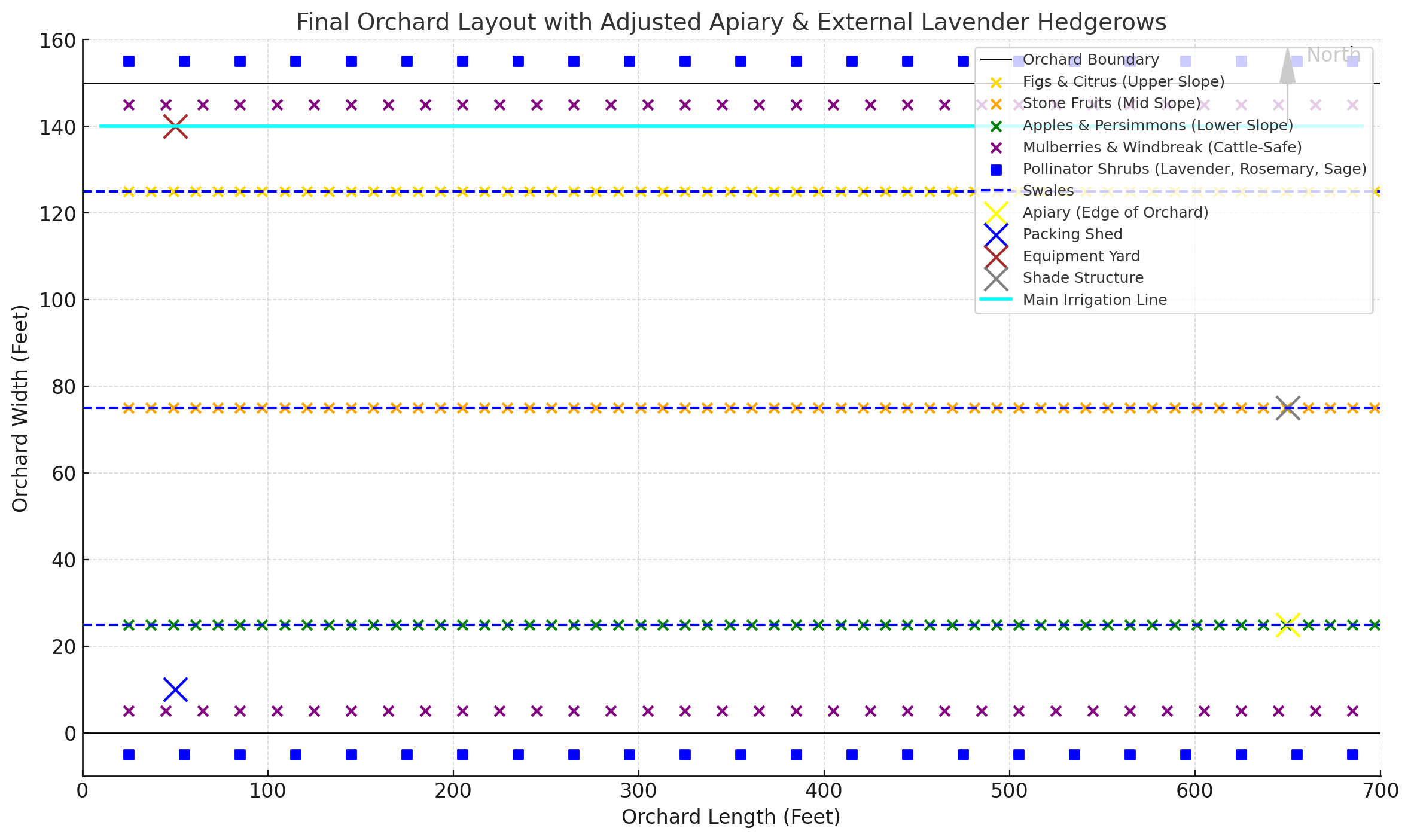
Diagram 3:
Final Orchard Design Summary
This finalized orchard layout integrates efficient fruit tree placement, cattle-safe windbreaks, pollinator hedgerows, and essential infrastructure while ensuring optimal water management and accessibility.
1. Tree Placement & Spacing
• Upper Slope (Drought-Tolerant Zone): 🌳 Figs & Citrus
• Spacing: 12 ft between trees, 15 ft between rows
• Planted parallel to contour swales to maximize water efficiency.
• Mid-Slope (Moderate Moisture Zone): 🍑 Stone Fruits (Apricots, Plums, Nectarines, Pluots)
• Spacing: 12 ft between trees, 15 ft between rows
• Central orchard zone for balanced soil moisture and pollination access.
• Lower Slope (Moisture-Retaining Zone): 🍏 Apples & Persimmons
• Spacing: 12 ft between trees, 15 ft between rows
• Planted along lower swales to utilize natural water retention.
2. Windbreaks & Pollinator Hedgerows
• Windbreak (Cattle-Safe): 🌳 Mulberries & Pacific Wax Myrtle
• Planted along north and west boundaries to block wind and protect fruit trees.
• Pollinator & Soil-Stabilizing Hedgerows: 🌿 Lavender, Rosemary, Sage
• Positioned OUTSIDE the windbreak line (along the external perimeter).
• Provides habitat for pollinators (bees, beneficial insects) and stabilizes the soil.
3. Swales & Irrigation System
• Swales (Water Retention Zones): 🌊
• Located at 25 ft, 75 ft, and 125 ft to slow and capture rainwater.
• Drip Irrigation System: 🚰
• Main water line runs along the upper slope.
• Drip emitters provide controlled irrigation to each tree row.
4. Infrastructure Placement
• Apiary (Beehives): 🐝
• Moved to the perimeter (lower-right edge) instead of centrally placed.
• Ensures safe distance from operations while supporting pollination.
• Packing Shed: 📦
• Located at the lower-left corner for efficient fruit collection & storage.
• Equipment Yard: 🛠
• Positioned in the upper-left for easy tool access near the entrance.
• Shade Structure: 🌿
• Placed near workspace areas for workers’ rest and equipment servicing.
5. Orientation & Accessibility
• North Direction Marked (Top Right).
• Paths & Irrigation Lines strategically planned for easy movement, maintenance, and harvesting.
Final Layout Objectives ✅
✔ Balanced spacing & tree placement for year-round fruit production.
✔ Cattle-safe windbreak & pollinator-friendly shrubs for ecosystem health.
✔ Water-efficient swales & irrigation system for sustainable farming.
✔ Optimized infrastructure placement for easy operation & management.
Final Approval ✅
This final layout is fully optimized for mini orchard goals. 🚜🌱🍎 🍊
[..]
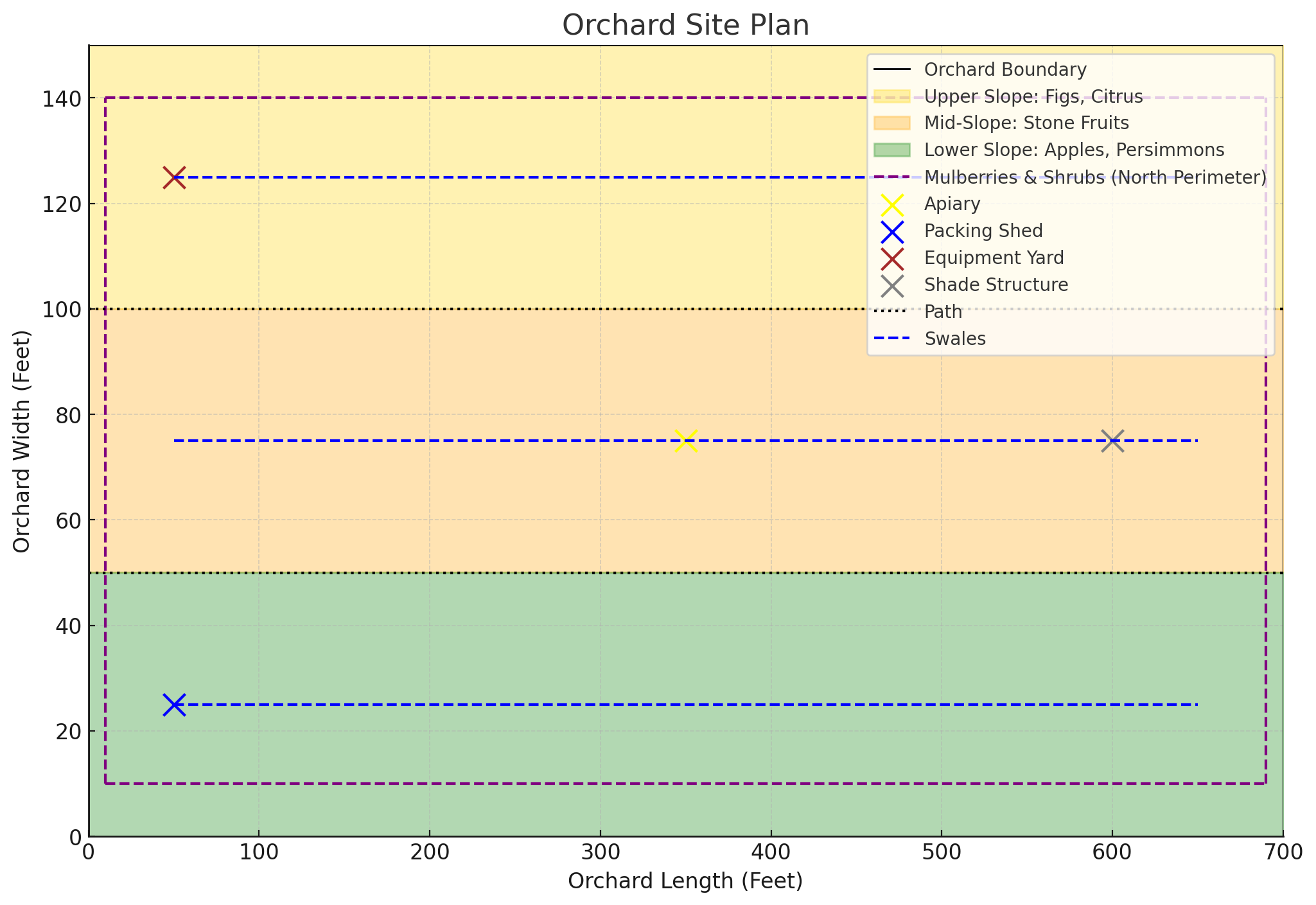
Diagram 1: represents the orchard layout with the following components:
1. Zones:
• Upper Slope (Yellow): Figs and citrus trees.
• Mid-Slope (Orange): Stone fruits.
• Lower Slope (Green): Apples and persimmons.
2. Protective Perimeter:
• Mulberries and shrubs (lavender, rosemary, sage) are planted around the boundaries (purple dashed lines) for windbreak and soil health.
3. Infrastructure:
• Apiary (Yellow marker): Centrally located in the mid-slope zone for efficient pollination.
• Packing Shed (Blue marker): At the lower slope near the road for easy transport and storage.
• Equipment Yard (Brown marker): At the upper slope near the entrance for easy access and storage.
• Shade Structure (Gray marker): Near the apiary for workers’ rest and maintenance activities.
4. Swales:
• Blue dashed lines indicate swales for water management, placed parallel to contour lines.
5. Paths:
• Black dotted lines indicate 10-foot-wide paths for vehicle and worker access.
This layout ensures efficient resource use, year-round fruit production, and sustainable soil and water management.
[..] Diagram 2:
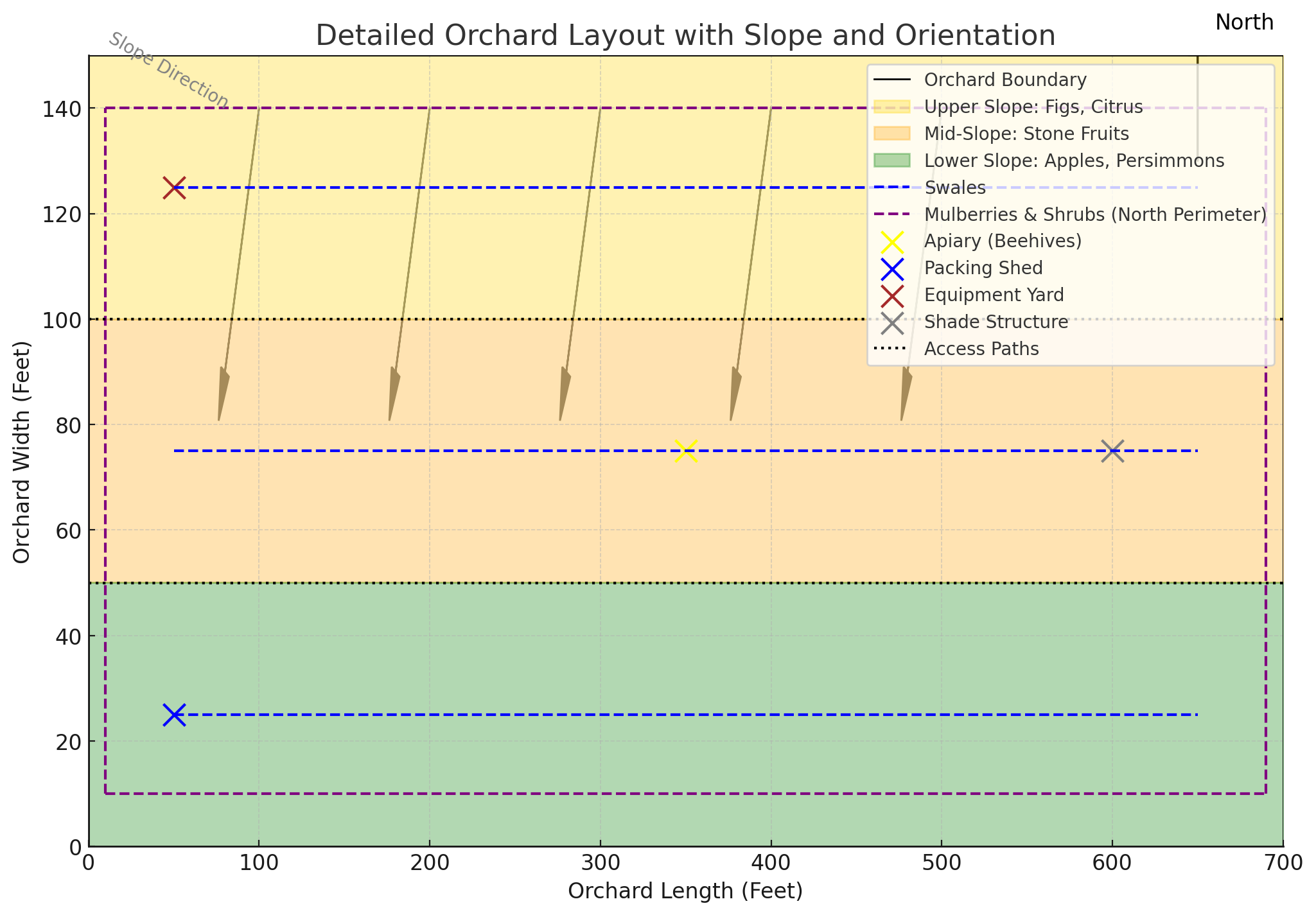
Here is a revised and detailed layout of the orchard, now reflecting the following:
1. Slope Direction:
• Indicated by arrows pointing downhill to show water flow and topographic gradients.
2. Orientation:
• North is marked at the top-right of the diagram.
3. Zones:
• Upper Slope (Yellow): Figs and citrus trees, with optimal conditions for drought-tolerant species.
• Mid-Slope (Orange): Stone fruits (e.g., apricots, plums, nectarines).
• Lower Slope (Green): Apples and persimmons, where more moisture collects.
4. Swales:
• Represented as blue dashed lines following contour lines to manage water flow.
5. Protective Perimeter:
• Purple dashed lines mark mulberries and shrubs planted around the orchard for wind protection and biodiversity.
6. Infrastructure:
• Apiary (Beehives): Centrally located in the mid-slope for optimal pollination coverage.
• Packing Shed: Positioned at the lower slope near the road for easy transport.
• Equipment Yard: Placed at the upper slope for convenient access to tools and machinery.
• Shade Structure: Located near the apiary as a rest and maintenance area.
7. Access Paths:
• Black dotted lines mark paths for maintenance and harvest access.
This plan ensures efficient resource utilization, year-round productivity, and sustainable water management.
Suggested Dwarf Fruit Tree Selection for Milpitas Orchard
This suggested orchard plan incorporates all recommended fruit trees optimized for Milpitas’ climate, featuring dwarf or semi-dwarf rootstocks, ensuring a diverse, productive, and well-balanced orchard for year-round fruit production.
🍊 Citrus
1. Improved Meyer Lemon – Sweet, juicy, fragrant lemons; ideal for fresh use and preserves.
2. Bearss Lime (Tahitian/Persian Lime) – Seedless, mild-flavored lime, great for drinks and cooking.
3. Washington Navel Orange – Seedless, easy-to-peel, classic sweet orange.
4. Kaffir Lime – Grown for its aromatic leaves and small tangy fruits.
5. Clementine Mandarin (Algerian) – Sweet, seedless, juicy, and easy to peel; ripens December–January.
6. Nagami Kumquat – Tart, oval-shaped fruits with a sweet edible skin.
7. Meiwa Kumquat – Sweeter, round kumquat with a soft, edible rind.
🍈 Figs
1. Black Mission Fig – Rich, dark purple figs with sweet, jammy flesh; excellent fresh or dried.
2. Brown Turkey Fig – Large, sweet, mild-flavored figs with brownish-purple skin.
3. Kadota Fig – Yellow-green figs with honey-sweet amber flesh; great for fresh eating or preserves.
🍑 Stone Fruits
1. Santa Rosa Plum – Sweet-tart, juicy, deep red flesh; thrives in the Bay Area.
2. Blenheim Apricot – Classic California apricot; intensely flavored, ideal for fresh eating and drying.
3. Gold Dust Peach – Early-ripening, golden-fleshed peach; juicy and flavorful.
4. Independence Nectarine – Bright red-skinned nectarine; firm and highly aromatic.
5. Flavor King Pluot – Sweet, spicy, and juicy plum-apricot hybrid.
6. Burgundy Plum – Mild, sweet, low-acid plum with reddish-purple flesh.
7. Mirabelle de Nancy – Small, yellow, honey-sweet French plum; great for preserves.
8. Old Green Gage (European Gage Plum) – Classic gage with a honey-like sweetness and greenish-yellow skin.
🍐 Persimmons
1. Fuyu Persimmon – Non-astringent variety; can be eaten firm and crisp.
2. Hachiya Persimmon – Astringent variety that ripens to a custard-like texture; great for baking.
🍏 Apples
1. Fuji Apple – Super-sweet, crisp, juicy apple; excellent for fresh eating.
2. Gala Apple – Mild, sweet, and crisp; a favorite snacking apple.
3. Anna Apple – Low-chill variety; produces crisp, sweet fruit suitable for warm climates.
🍐 Pears & Quince
1. Bartlett Pear – Juicy, aromatic, classic pear for fresh eating and canning.
2. Seckel Pear – Small, ultra-sweet “sugar pear”; great for fresh eating and preserves.
3. Anjou Pear – Firm, sweet, and excellent for long storage.
4. Pineapple Quince – Large, aromatic quince with a hint of pineapple flavor; great for baking and preserves.
🌿 Jujube
1. Li Jujube – Large, sweet, crisp fruits that can be eaten fresh or dried.
2. Lang Jujube – Pear-shaped fruits with an apple-like flavor, best when dried.
🍒 Additional Fruit Suggestions (Optional)
If space allows, these climate-friendly dwarf fruit trees could be added for even more diversity:
• Pomegranate (Wonderful) – Self-fertile, produces deep red, sweet-tart fruit.
• Mulberry (Dwarf Everbearing) – Small, productive tree with sweet black fruits; excellent for fresh eating and jams.
• Loquat (Big Jim or Gold Nugget) – Small, cold-hardy tree producing tangy-sweet, golden-orange fruits.
🔹 Summary & Considerations
✔ Balanced Fruit Production – Ensures year-round fruit availability.
✔ Pollination Compatibility – Cross-pollinators included where needed (e.g., pears, plums).
✔ Dwarf & Semi-Dwarf Rootstock – Compact trees for a structured orchard layout.
✔ Climate-Appropriate – Selected for Milpitas’ Mediterranean climate.
🚜 This is the suggested orchard tree list, ensuring maximum productivity, biodiversity, and resilience. 🌿🌳🍊