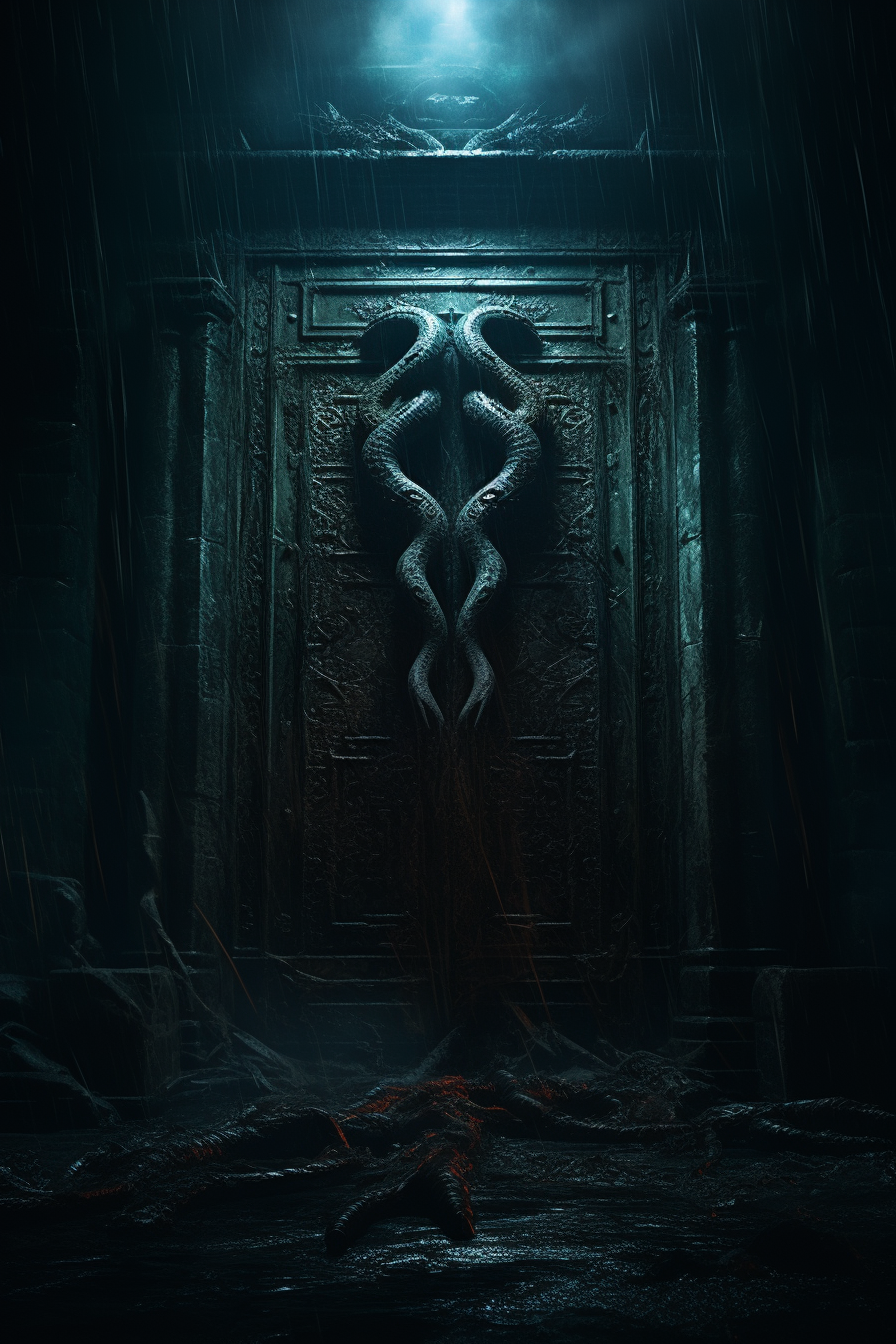
NAGA DWARAM
Deep in the heart of Kerala, surrounded by thick forests and forgotten by time, lay the ruins of an ancient temple. Its once grandeur was reduced to crumbled walls and overgrown shrubs. However, the Naga Dwaram, the serpent gateway, remained eerily intact. The intricately carved Naga figures on its doors seemed almost alive under the moonlight, their cold stone eyes reflecting a soft glow.
Years ago, two playful little girls, Meera and Shwetha, were best friends and inseparable. One day, they decided to play hide and seek, wanting to challenge each other in the most intriguing places. As they scoured the village for an ideal location, the eerie yet majestic temple caught their attention. Ignoring the cautionary tales they had heard, the thrill of adventure overcame their fear.
Meera went in to hide first, while Shwetha counted. As Meera tiptoed through the dilapidated temple, a beautifully carved door with intertwined snakes caught her eye. Unbeknownst to her, the snake carvings on the door were rumored to come alive to protect the temple’s secrets. As she reached out to touch it, one of the snakes came alive and bit her. Panicking and in pain, Meera let out a piercing scream.
Hearing her friend's cry, Shwetha ran towards the sound, but the moment she entered the room, the intricately carved door slammed shut behind her, locking them both inside. Desperate to save her friend, Shwetha tried to find an exit but to no avail. The temple’s walls seemed to close in on them, and the echoes of their cries for help went unheard.
The village folks soon realized the girls were missing and started searching for them. When they reached the old temple and heard the girls' faint cries, they tried to break open the door, but it wouldn't budge. Despite several attempts, the villagers couldn't rescue the girls, and the temple’s stone walls swallowed their voices.
Years passed, and the tragic tale of Meera and Shwetha became legend. The old temple still stood as a haunting reminder of the lost souls. No villager dared to venture near it, but many claimed that on full moon nights, they could hear the laughter of two little girls echoing from inside. Those brave enough to peer in under the full moon’s light reported seeing Meera and Shwetha, still in their childhood forms, gleefully playing hide and seek, their spirits forever bound to the ancient temple they had dared to enter.

NAGA MATRIKA
Amidst the lush green forests of Madhya Bharat, there stood the ancient city of Nagashila. The city, with its ornate temples and grand palaces, was a picture of prosperity and peace. But this serenity was shattered when an army of marauders, lured by tales of the city's wealth, descended upon Nagashila.
Among the city's residents was Devika, a woman of unparalleled beauty and grace. She was a healer and medicine woman. She was a snake whisperer who knew how to make medicine from snake venom. As though they were docile pets, the snakes of the woods willingly came to her to give her their venom.
She lived in a humble abode at the edge of town, surrounded by the laughter and love of her three children. But the fateful night the marauders attacked, Devika's world crumbled.
Her home was razed to the ground, and her children were taken away by the invaders, their fate unknown. Devastated and driven by grief, Devika cursed the soldiers who had robbed her of everything.
With her dying breath, she vowed to wait at the city gates for each soldier's soul, ensuring they'd never find solace in the afterlife.
Years turned into decades, and the legend of the "Naga Matrika" grew.
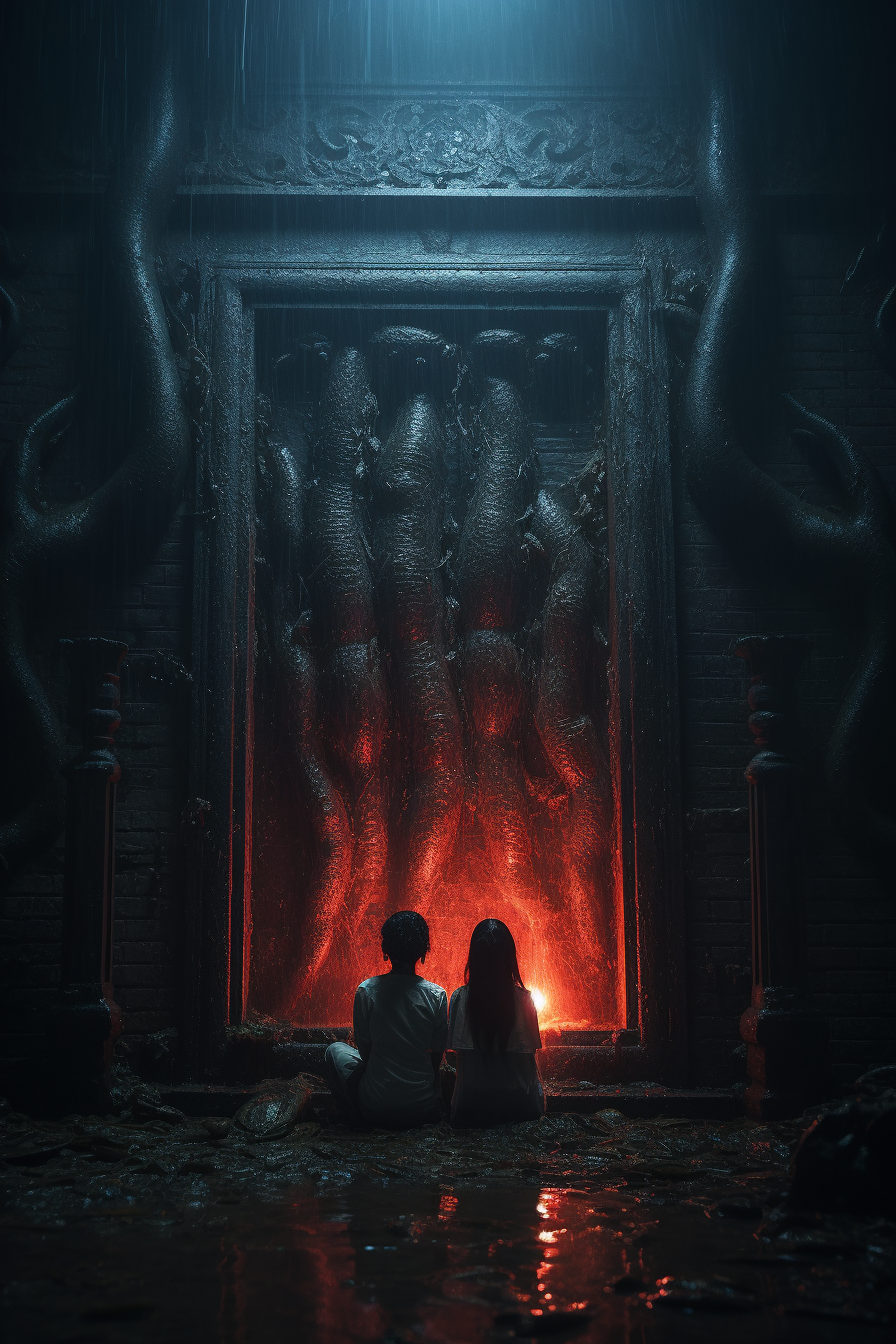
It was said that a silhouette of a woman, holding a lamp, could be seen at the ancient gates every night, her silhouette shimmering in the haunting red glow.
Soldiers who had participated in the conquest of Nagashila, found themselves drawn to these gates after death. It was whispered that many of the soldiers died due to snake bites. As they approached, they would see Devika's ethereal form holding a lamp, her eyes filled with sorrow and rage.
One by one, she would confront them, recounting their deeds and ensuring they felt the weight of their sins. Then, with a gesture, she would condemn their souls to wander the earth, lost and restless, for eternity.
Travelers passing through the ruins of Nagashila would often feel an inexplicable chill, hearing faint whispers of regret carried by the wind. And on the darkest nights, if one were brave enough to approach the ancient gates, they might just see the ghostly figure of Devika, the guardian spirit of Nagashila, waiting for the next soul to claim.

NAGA RAKSHAK
In a quiet mountain town, situated in the shadows of the Himalayas, an ancient tale was whispered among the villagers. It spoke of a serpent guardian known as Naga Rakshak. Centuries ago, the royal treasures of the kingdom were sought after by conquerors and thieves alike.
To protect the town and its treasures, a powerful sage summoned the spirit of the great serpent, Ananta, to create a guardian. This guardian, known as Naga Rakshak, was bound to the temple's inner sanctum, where the treasures lay.
With the body of a man, hood of a cobra, and eyes that gleamed like molten gold, Naga Rakshak was to remain dormant, awakening only when the temple was threatened. Lore of his presence was enough to send chills down the spine of any intruder. Few wud ever dare to face him.
The treasure was untouched for years. Decades turned to centuries, the tale of Naga Rakshak faded into legend and the temple's location too was lost to time. But greed has a way of resurrecting old tales.
A treasure hunter named Vikram, having heard whispers of the temple's riches, embarked on a quest to find it. Youth knows no fear and has no dearth of company. Sprinkle a little promise of adventure and now he had a team.
Vikram and his team found the entrance hidden behind a waterfall. They ventured deep into the temple, ignoring the ancient inscriptions warning of the guardian. As they reached the inner sanctum, a cold wind swept through the temple, extinguishing their torches.
It was but a split second. From the darkness emerged Naga Rakshak, his eyes glowing fiercely. The walls echoed with his ominous hiss and the ground trembled beneath him. Paralyzed with fear, the intruders could only watch as he lunged at them with his centuries old fury.
The next morning, the local villagers discovered the entrance to the temple open and the insides in disarray. Of Vikram and his team, there was no trace, save for a single, tattered map. The treasures remained untouched or so the villages thought.
The temple was sealed once again, and the villagers added a new chapter to the legend of Naga Rakshak. Pujas were performed to assure the Great Serpent Protector of their obedience. New inscriptions were added.
To this day, the brave and the foolish continue to seek those treasures, but none who have entered the temple have ever returned, save for tales whispered in the wind, reminding all of the wrath of the Serpent Protector.

THEEN MATRIKAS
In the foothills of the Himalayas, in a remote village named Harapathar, lived three sisters. Their names have been lost to time, but we know that they were known as the Matrikas of Harapathar. As Ancient Guardian Mothers, they were revered by the villagers for their deep knowledge of the ancient rituals and healing practices.
Adorned in vibrant colors, tribal tattoos, and jewelry made of shells and bones, the trio had an aura of mysticism surrounding them. Legend has it that the sisters were granted a boon from the Gods, which allowed them to communicate with the spirits of the mountains.
They performed sacred rituals to ensure the village's safety, for Harapathar had a dark secret. Beneath its serene beauty lay a dormant spirit, Amba, a mountain nymph…a Yakshini.. who, when angered, could bring calamity upon the village.
One fateful night, a group of British archeologists from a distant land, having heard tales of a hidden secrets within the mountain, ventured into Harapathar. Ignoring the warnings of the villagers and the three sisters, they began their excavation.
The disturbance awoke Amba, and her wrath was swift and devastating. Torrential rains, landslides, and violent winds struck Harapathar. The outsiders were swept away, but the villagers were not to be spared of Amba’s fury. The three sisters, understanding the gravity of the situation, began an intense ritual to appease Amba.
The ritual required them to offer their own physical forms made of flesh and blood to the mountain in exchange for the village's safety. It was a bargain that cannot ever be undone. As they chanted their final prayers, a brilliant light enveloped them as they descended into a gorge that opened and vanished, leaving behind only their echoing voices.
The storm subsided, and the village was saved, but at a great cost. To this day, on moonlit nights, villagers claim to see the ethereal forms of their guardian mothers, wandering the mountain paths, their skin shimmering and their voices singing ancient hymns.
They serve as a constant reminder of the sacrifice made to protect Harapathar and the price of greed. And while Amba’s rage was calmed, the guardians of Harapathar continue their watch, ensuring that the spirit of the mountain remains undisturbed.
The villagers could sleep soundly knowing that the sisters wandered outside in their formless forms protecting them forever. The village is now a bustling town, but when the skies darken and seem angry, those who still remember the old tale mutter a plea to the Matrikas of Harapathar. Their names may have disappeared in the mist of time , but the protection they promised will remain as long as the memory of the tale of the three sisters lives on.
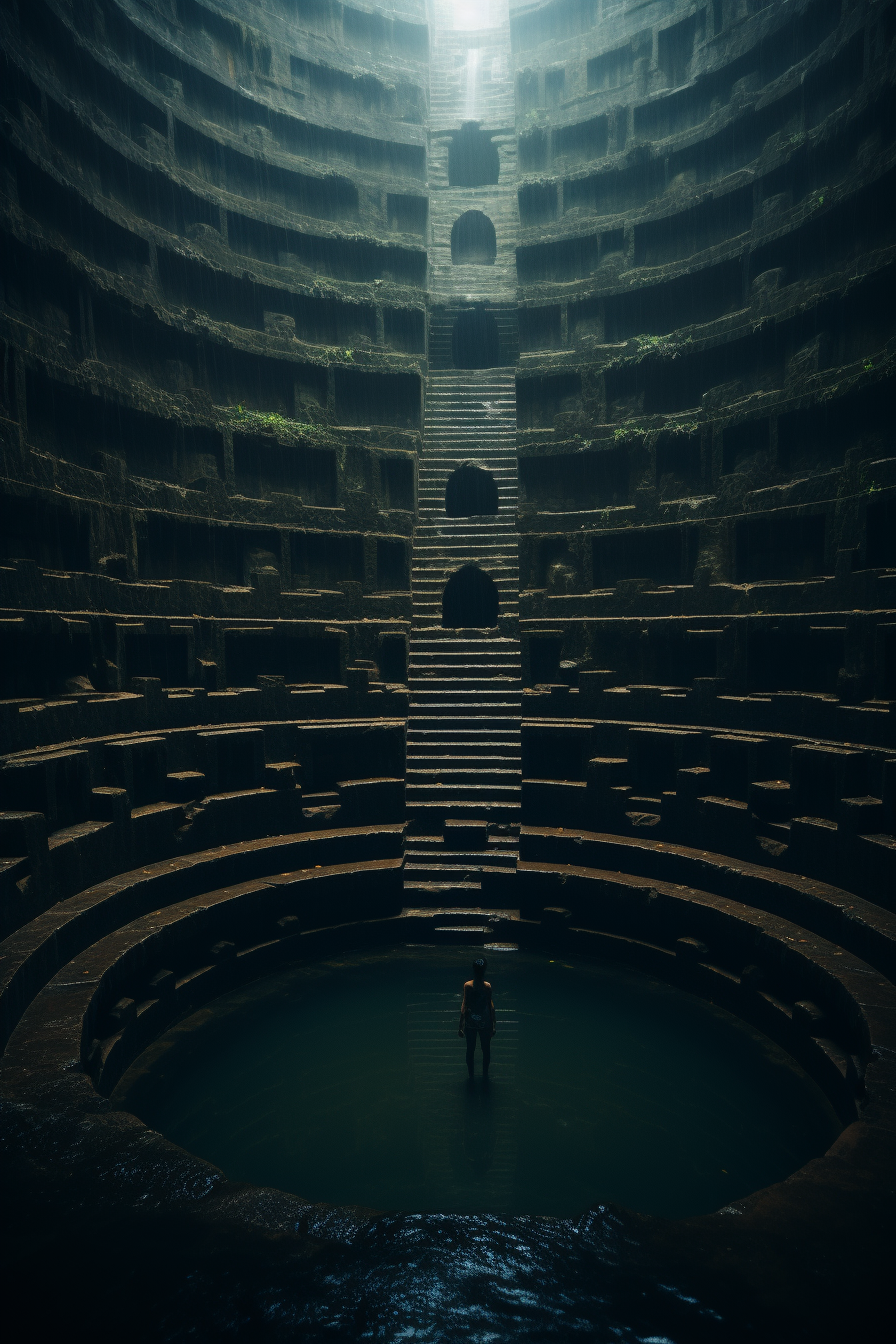
KALA BAOLI
In the forgotten heart of ancient India, an ancient stepwell that was known to all as "Kala Baoli" stands, its history shrouded in darkness and mystery. "Kala" means dark, and the stepwell was named so not just for its shadowy interiors but for the legend it beheld.
The villagers who live around this ancient stepwell that is now in ruins speak of a dancer named Mohini, renowned for her beauty and grace. She would dance on the topmost steps of the stepwell, casting enchanting shadows that would dance along the well's deep walls. Her performances drew admirers from distant lands, including a prince of the land named Visarga who became smitten with her.
Visarga pursued Mohini, showering her with gifts and praises. But she, being devoted to the art and the divine, rejected his advances. Enraged by this rejection, the Prince accused her of witchcraft and sentenced her to be drowned in the very stepwell she danced upon.
As she was dragged to the dark depths of Kala Baoli by her long dark hair, Mohini cursed the stepwell, proclaiming that its waters would mirror the darkness of Visarga’s heart, and anyone who ventured into it would be ensnared by her dance for eternity.
Decades passed and the once bustling site of Kala Baoli became desolate with villagers avoiding it at all costs. But occasionally, a traveler unaware of the legend would come by. Drawn by the eerily calm water, if they ventured in, they would see a mesmerizing dance performance reflected on the water's surface.
As they'd watch, entranced, they'd find their feet slowly moving, dancing uncontrollably, until they were pulled under by an invisible force.
Now, on moonlit nights, locals claim they can hear the faint sound of ghungroos and see fleeting shadows dancing on the stepwell's walls. Many believe that it's Mohini, still performing her dance, waiting for the next soul to be captivated by her eternal performance.
Those who pass by Kala Baoli are always advised: admire its ancient beauty, listen to its echoing tales, but never, ever step into its waters. For in its depths, dance and doom entwine. Death awaits.